
From personas to personalisation: how Contensis helps you adapt key user journeys

User personas only add value when they shape the experiences people have on your website. In User Personas 101, we explored how well-researched personas help teams make better decisions by grounding content in real user needs, motivations, and questions. They give you clarity about who you’re designing for, and what matters to them most.
But understanding your users is just the starting point. The real impact comes when you can adapt your content and journeys to reflect what different users need in the moment. Whether you’re supporting prospective students, helping residents complete tasks, or guiding customers through complex information, relevance plays a critical role in helping people succeed.
That’s where personalisation becomes useful – not as a marketing tactic, but as a way of delivering the right support to the right users at the right time.
With the latest release of Contensis, teams can now turn their personas into practical, personalised experiences without adding complexity or compromising privacy. By combining structured content with a client-side, privacy-first approach to personalisation, Contensis gives you a sustainable way to tailor key moments in your user journeys.
Why personas are the foundation of effective personalisation
Personas give you a clear picture of the different groups using your site: what they’re trying to do, the questions they ask, and the points where they may struggle. That understanding is essential for deciding where personalisation will add value – and where it won’t.
Effective personalisation isn’t about showing different content to as many users as possible. It’s about identifying the moments where tailored guidance, reassurance, or signposting can genuinely help someone move forward.
Personas help you pinpoint:
- the goals that matter most to each audience
- the questions that shape their decisions
- the parts of a journey where they need extra clarity or support
And because space on your site is finite, personas help you decide which content deserves prominence for which users. Personalisation then allows you to adapt those limited areas – such as key panels, CTAs, or navigation items – to the users who will benefit most.
Contensis builds on this foundation by giving teams the tools to translate persona knowledge into practical, sustainable personalisation.
How personalisation works in Contensis
Once you’ve identified where personalisation will genuinely help your users, the next step is working out how to deliver it in a way that’s maintainable for your team.
Contensis provides a structured model that lets you apply what you’ve learned from your personas without duplicating content or introducing unnecessary complexity.
It does this through three building blocks:
Signals
Signals capture simple, non-intrusive details from the browser – such as a visitor’s location, device type, referrer, or browsing patterns. These indicators help you understand the context someone is arriving with and how their behaviour aligns with your personas. Think of signals as clues which indicate which one of your personas a visitor might be most similar to.
Signals might include:
- a visitor from outside the UK
- someone exploring a specific subject or service area
- a returning user
- a first-time mobile visitor
They don’t tell you everything about a user, but they provide enough context to adapt key parts of a journey in useful ways.
Custom attributes
Browsing and device information is useful, but many organisations also hold structured information about users that comes from elsewhere in their digital estate. This could include information stored in a CRM, a student information system, an IAM solution such as Microsoft Entra, or a customer service platform. In Contensis, this information can be represented as custom attributes.
Custom attributes are set up by developers. Once created, editors can use them inside signals just like any other attribute.
They can represent things like:
- logged-in user roles (for example, staff, student, resident)
- membership levels or plans
- internal categories, such as areas of interest
- outcomes of key interactions, such as completing a form or making a purchase
- any other structured data your organisation uses to distinguish audience groups
For example, if developers expose a userType attribute based on the profiles of logged-in users, editors can create a signal that fires when userType equals “Student”. This allows the personalisation model to reflect the audience structure already used across your organisation.
Audiences
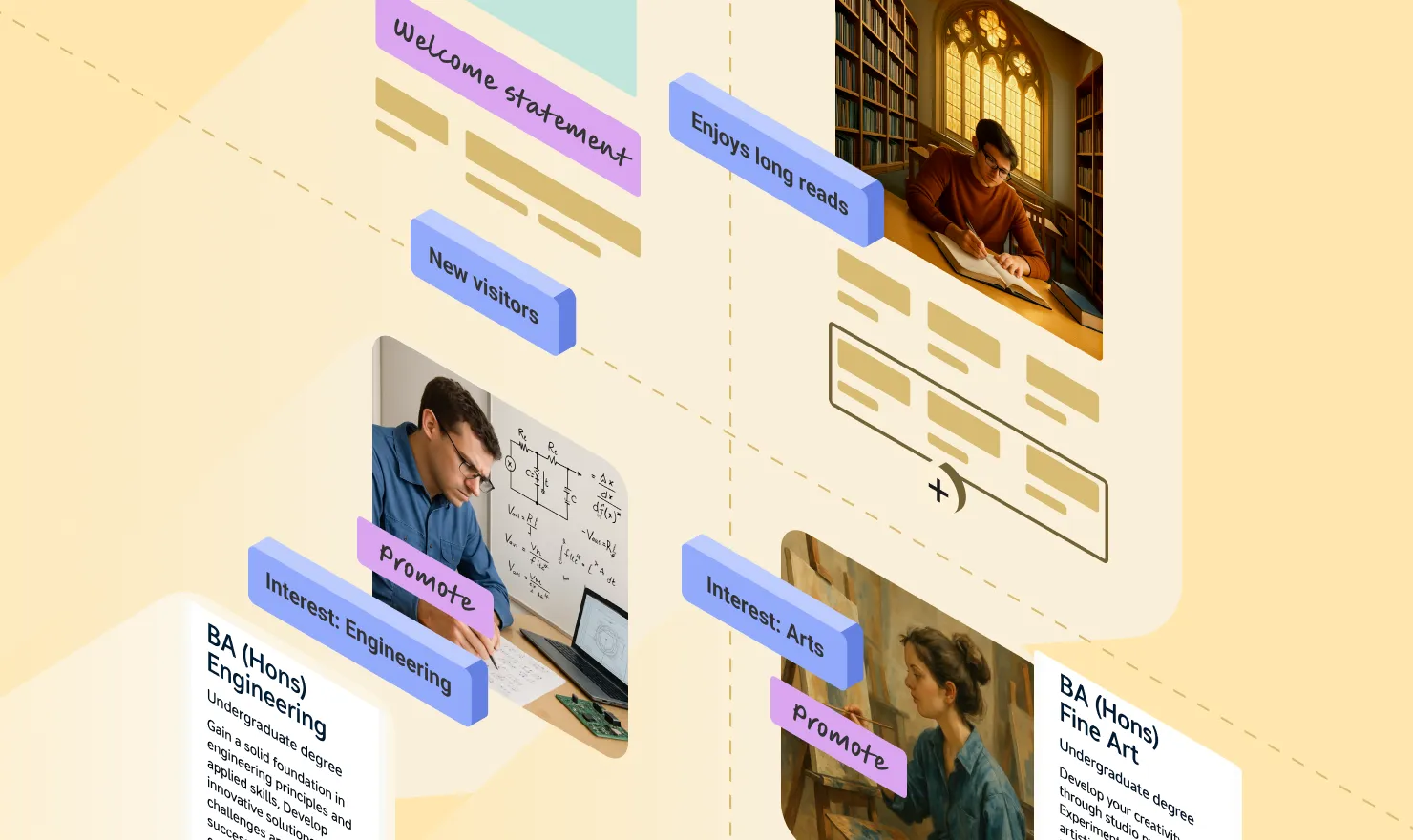
Audiences are groups of visitors who share common characteristics, allowing you to target and personalise content for them. Each audience represents a segment you want to target with specific content, such as different calls-to-action, localised campaign panels, or tailored content recommendations.
An audience is made up of one or more conditions. Those conditions are built from signals – and signals may themselves use custom attributes if your developers have created them. This gives you a flexible way to reflect the distinctions captured in your personas without building separate pages or duplicating content.
Personalisation becomes especially helpful when you consider how little space you have to work with. A homepage, a banner, or a key call-to-action can only show one thing at a time. Audiences give you a way to use that space differently for different visitors, so each group sees what’s most relevant to them without overwhelming everyone else.
Audiences can represent simple groupings, such as:
- visitors on mobile devices
- users arriving from a specific referrer
- people browsing a particular topic area
Or they can reflect more structured persona-like groups, such as:
- International visitors
- Returning users interested in engineering
- Logged-in residents accessing council services
Because audiences can reference each other, you can also nest them to create more specific targeting – for example, visitors from outside the UK who have also shown interest in postgraduate courses.
Once you’ve defined an audience, you can use the audience picker in Contensis to decide which version of a component should be shown to that group. The picker appears on any component that has been built to support personalisation. Editors simply choose one or more audiences, and Contensis displays the appropriate variant when a visitor matches the audience conditions. This allows you to personalise individual components without needing to create separate pages or complex branching structures.
In practice, audiences become a manageable, transparent proxy for your personas. They let you take what you know about each user group – their motivations, questions, and challenges – and express that knowledge in rules that teams can review, preview, and adjust over time.
Privacy-first implementation
Unlike many personalisation systems, Contensis doesn’t rely on third-party cookies, cross-site tracking, or server-side user profiling. All signal and audience information is stored in the visitor’s browser using first-party storage. This means:
- the data never leaves the visitor’s device by default
- Contensis doesn’t maintain individual profiles
- no personal information is transmitted unless your project explicitly chooses to
Another benefit of this approach is that personalisation isn’t affected when visitors decline non-essential cookies. Because Contensis doesn’t depend on third-party tracking technologies, personalised experiences continue to work even when cookie consent is declined – meaning more users receive relevant, helpful content.
For teams in higher education, local government, and enterprise environments – where compliance, public trust, and transparency matter – this approach makes it easier to manage personalised experiences while complying with relevant legislation and respecting users’ right to privacy.
Mapping personas to personalised experiences
Once you understand your personas and where personalisation could make a difference, the next step is working out how to translate that insight into something practical. A useful approach is to start with one or two personas that either stand to benefit most from targeted content or offer the strongest potential return on investment.
From there, focus on what those users are trying to achieve – the motivations, questions, and barriers that shape their journey. This helps you identify which content variations or tailored experiences would support them best.
The next stage is to work out how to recognise visitors who resemble those personas. In practice, that usually means identifying the behaviours or attributes that signal a visitor’s intent or circumstances. These can then be expressed as signals in Contensis, with custom attributes created where you need more precision.
Once you’ve defined the right signals, you can combine them into audiences that act as practical proxies for your personas. From that point, it’s simply a case of creating the personalised component variants that will appear for each audience.
The examples below show how this process works in practice.
Higher education
Prospective undergraduate
Persona insights:
- Motivations: choosing a course that aligns with interests and long-term career goals; finding a university with a strong reputation and supportive student experience
- Questions: “What can I do with this degree?”, “What are the entry requirements?”, “What is student life like at this university?”
- Likely behaviours: comparing subject areas and course pages, exploring modules and assessment methods, checking league tables and graduate outcomes, watching student videos, and reading FAQs to understand application steps
In Contensis:
- Signals: browsing course pages, UCAS referrals, repeat visits
- Audience: Prospective undergraduate
- Tailored components: student stories, subject-specific events, career-focused CTAs
Mature student balancing work and study
Persona insights:
- Motivations: flexible study options, ability to upskill or retrain, support for juggling work, life, and education
- Questions: “Can I fit this course around my existing commitments?”, “What support is available for part-time or distance learners?”
- Likely behaviours: reviewing part-time and online course formats, checking timetables and workload expectations, reading about student support services, exploring funding options for mature learners
In Contensis:
- Signals: viewing flexible study content, exploring funding information
- Audience: Mature learner
- Tailored components: guidance panels, part-time study information
International learner
Persona insights:
- Motivations: global career prospects, reputable qualifications, safe and supportive study environment, opportunities to integrate into student life
- Questions: “What are the entry requirements for international students?”, “How do visas and accommodation work?”, “Will I get language and academic support?”
- Likely behaviours: browsing international admissions pages, checking visa guidance, comparing tuition fees and scholarships, reading student stories from their home region, exploring campus life and support services for international students
In Contensis:
- Signals: IP-based location, viewing international content
- Audience: International visitor
- Tailored components: visa guidance, accommodation information, country-specific CTAs
Local government
New council resident
Persona insights:
- Needs quick access to essential tasks and reliable signposting.
In Contensis:
- Signals: referrer from search, repeated visits to council tax or waste sections
- Audience: New resident
- Tailored components: shortcuts to bins, council tax, and local facilities
Resident reporting an issue
Persona insight:
- Often arrives via search, wants the quickest possible route to “report” actions, and may already be frustrated.
In Contensis:
- Signals: visits to “report it” pages, repeated navigation patterns, mobile device usage (common for on-the-go reporting)
- Audience: Issue reporter
- Tailored components: direct “report an issue” CTA, location-based prompts, links to the most used report categories
Parent or carer looking for local services
Persona insights:
- Needs information about schools, childcare, SEND support, or family services. Often time-pressured.
In Contensis:
- Signals: browsing education, childcare, and SEND content; local search referrals
- Audience: Parent/carer
- Tailored components: quick links to admissions, childcare support, SEND services, school term dates, and local family hubs
All of these experiences are powered by the same structured content. You’re not duplicating content entries or maintaining separate pages, you’re defining when certain components should appear for different audiences. This is particularly useful in areas where space is tight, such as landing pages, service pages, or key action panels.
Bringing everything together
User personas help you understand your audiences. Personalisation helps you act on that understanding.
Contensis brings these two things together in a way that’s flexible, privacy-first, and sustainable. You can tailor key moments in your user journeys without increasing complexity or relying on third-party tracking – and make better use of the limited space you have by showing each audience the content that supports them best.
If you’re beginning to introduce personalisation, it helps to keep the scope small: choose one or two key journeys, create the audiences that matter most for those users, and personalise a handful of components that will make a meaningful difference. Once you’re confident in the approach, it’s easy to extend it to other personas and journeys.
Personalisation is available now in Contensis 17.1. If you're an existing Contensis customer, raise a support request today to schedule an upgrade to 17.1 to take advantage of personalisation and other new features.
If you're not currently using Contensis, and want to find out more about how you could benefit from personalisation, forms, and other new features, get in touch to arrange a demo.